

That sinking feeling when you sit down isn’t just annoying—it’s your office chair screaming for retirement. Most people wait until wheels fall off or cushions flatten completely before wondering how long do office chairs last. But understanding your chair’s true lifespan prevents back pain disasters and saves money. Whether you’re a home office warrior or managing corporate furniture, knowing exactly when chairs fail lets you replace strategically—not reactively. The difference between a $200 budget chair and a $1,200 premium model isn’t just comfort—it’s measured in years of reliable support and thousands of productive hours.
Your chair’s lifespan spans wildly—from 1 year for flimsy discount models to 15+ years for commercial-grade thrones. The critical question isn’t just how long do office chairs last, but how long your specific chair will serve you before becoming a health hazard. Let’s decode exactly what determines your chair’s expiration date.
Office Chair Lifespan by Price Category
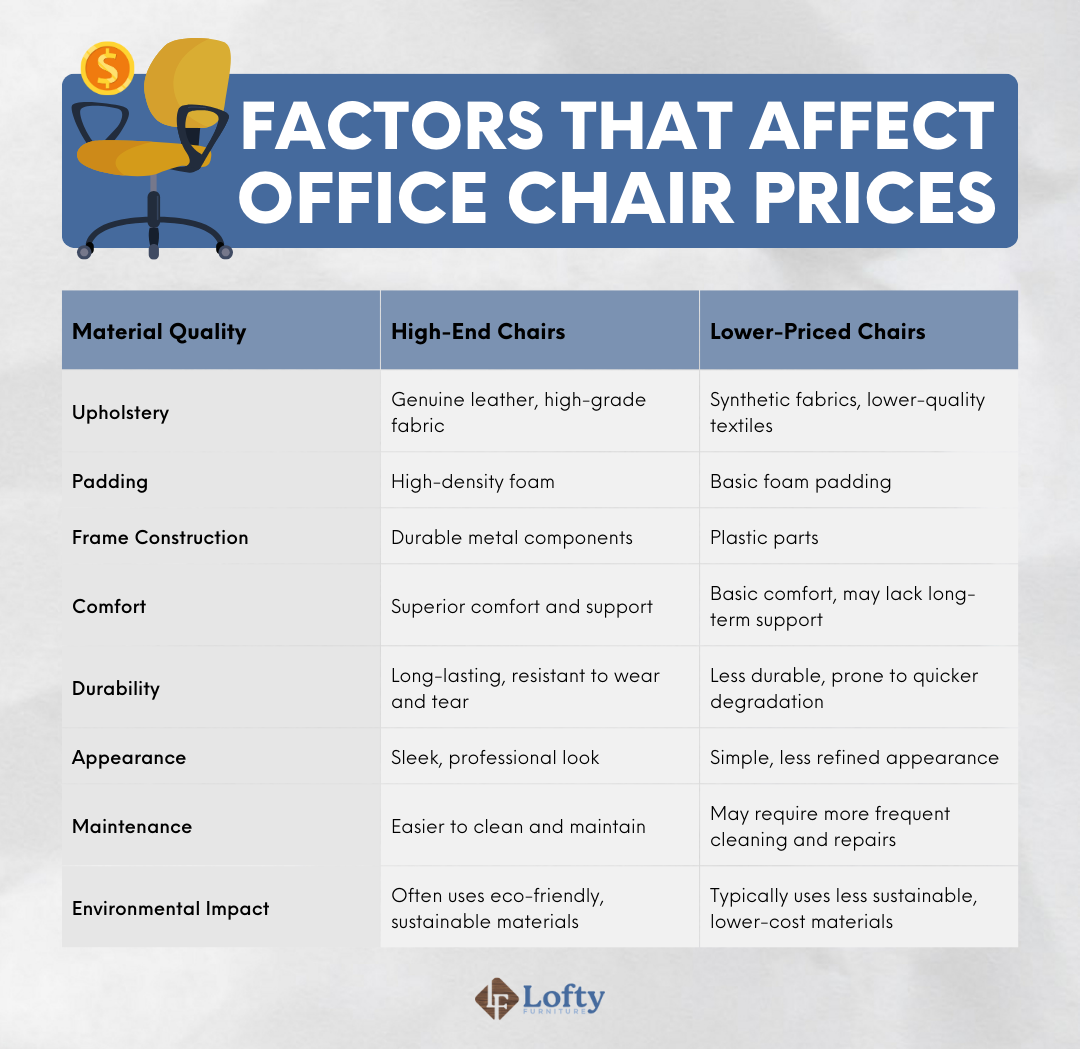
Price predicts longevity with startling accuracy—here’s exactly what to expect from your investment.
Ultra-Budget Chairs ($50–$150): These seats collapse fastest, lasting 1–3 years before critical failures. Low-density foam turns to pancake within 18 months, plastic frames crack under daily stress, and minimal adjustability means you’re stuck with whatever ergonomics degrade to. Warning: If your chair cost less than your monthly coffee budget, assume it’s on borrowed time.
Budget Range ($100–$200): Expect 2–5 years of service before synthetic leather peels like sunburnt skin and thin fabric frays at pressure points. Basic mechanisms develop wobble or squeaks that no amount of tightening can fix. These chairs often fail when you need them most—during critical deadlines.
Mid-Range Options ($300–$600): This sweet spot delivers 5–7 years of reliable use. Sturdier steel frames resist bending, better upholstery maintains appearance longer, and moderate ergonomic adjustments continue functioning throughout the chair’s life. Pro Tip: This is where most professionals get the best value—enough durability without enterprise pricing.
High-End Ergonomic ($600–$1,200): Quality chairs here serve 7–10+ years. Steel or aluminum bases resist corrosion, high-density foam retains 75% of original support after a decade, and full adjustability mechanisms remain smooth with proper maintenance. Herman Miller models routinely hit 12–15 years with their industry-leading warranties.
Premium Commercial-Grade ($1,200+): These workhorses operate 10–15 years under brutal conditions. Reinforced components withstand multi-shift abuse, extended warranties cover critical parts, and superior materials age gracefully rather than failing catastrophically. La-Z-Boy office chairs typically deliver 8–10 years, while the Nautilus Aura High-Back Leather proves exceptionally durable—professional re-upholstery can extend its life even further.
Brand Longevity Benchmarks You Can Trust
Herman Miller sets the gold standard with 12–15 year lifespans backed by matching warranties. Steelcase chairs deliver 10–12 years for corporate environments, while IKEA’s premium range averages 5–7 years with disciplined maintenance. Crucially, warranty length often mirrors realistic lifespan—ignore brands offering 2-year coverage on “premium” chairs.
Material Durability Decoded: What Actually Matters
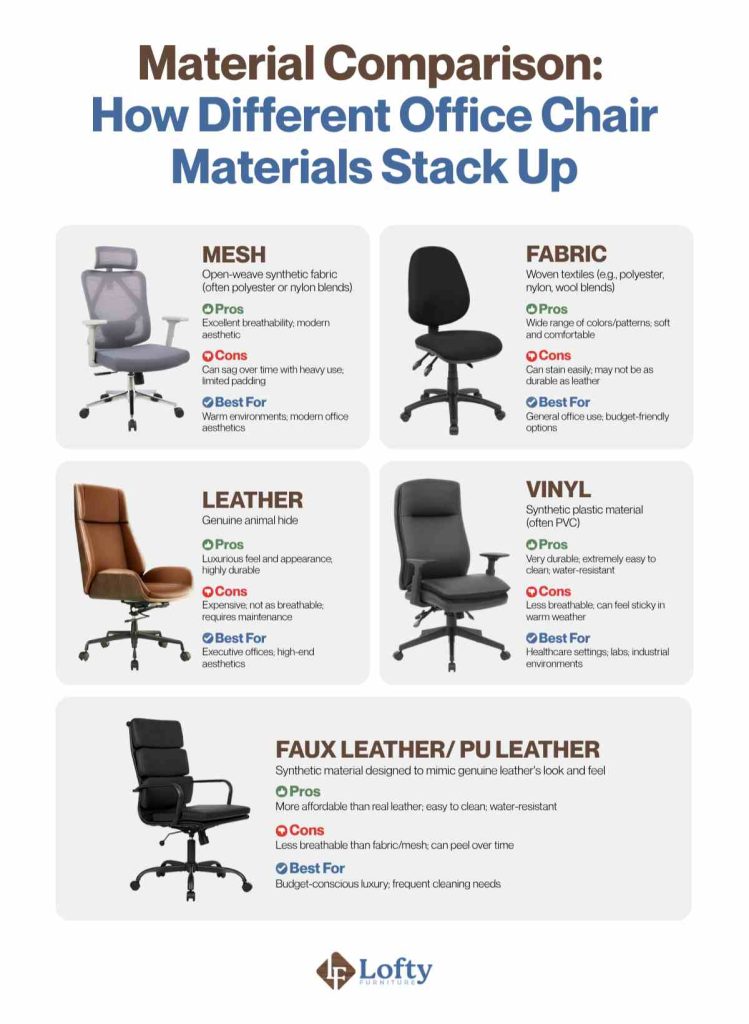
Your chair’s upholstery choice dramatically impacts its staying power—here’s the hard data.
Fabric chairs provide approximately 8 years of service when maintained properly. Monthly vacuuming prevents grit from grinding fibers, spot-cleaning spills immediately prevents staining, and keeping chairs out of direct sunlight preserves color. Common failures include tearing at pressure points (especially armrests), sunken seating areas, and pilling on high-contact surfaces. Critical sign: If you see permanent indentations deeper than 1 inch, support is gone.
Leather upholstery rewards proper care with 10–15 years of elegant service. Conditioning every 3–6 months prevents cracking, while avoiding direct heat sources maintains suppleness. Premium leather develops character with age rather than failing catastrophically—though seam separation and color fade occur without maintenance. Pro Tip: Test leather by pressing your thumb—if it leaves a permanent dent, foam compression has begun.
Mesh seating typically lasts 6–8 years, with high-end mesh extending to 10 years. Regular dusting prevents particle buildup that abrades fibers, while avoiding sharp objects protects against punctures. The most common failure is stretching that creates sagging, followed by tearing at stress points where mesh attaches to frame. Warning: If your mesh has visible “waves” when sitting, replacement is imminent.
Vinyl and PU leather offer the shortest material lifespan at 3–5 years. These require gentle cleaning with damp cloths and avoidance of harsh chemicals that accelerate peeling. Punctures from belt buckles or sharp objects create permanent damage that spreads over time. Red flag: Any peeling wider than a quarter means structural failure is coming.
Hidden Factors That Slash Chair Lifespan by 40%
Beyond price and materials, invisible forces dramatically impact how long your office chair lasts.
Usage Intensity Reality Check
Standard office use—8 hours daily, 5–6 days weekly—is the baseline warranty assumption. But multi-shift operations or 24/7 call centers slash lifespan by 25–40% due to accelerated foam compression. Conversely, home office chairs used under 4 hours daily often exceed average lifespan by 20–30%. Key insight: Your chair’s odometer matters more than calendar age—track usage hours for accurate replacement planning.
User Weight and Movement Patterns
Consistently exceeding rated weight capacity (typically 250–300 pounds) accelerates gas cylinder failure exponentially. Sitting habits matter too—rocking motions stress tilt mechanisms beyond design limits, perching on one edge creates uneven foam compression, and abrupt reclining strains frame joints. Pro Tip: If you hear “creaks” during movement, your chair is enduring 2x normal stress.
Environmental Assassins
Humidity above 60% accelerates fabric and foam degradation through moisture absorption, while humidity below 20% embrittles plastics. Temperature extremes prove equally destructive—heat above 90°F softens foam and adhesives, while cold below 40°F stiffens mechanisms. Direct UV exposure fades upholstery and weakens polymer components within 1–2 years. Critical action: Move chairs away from south-facing windows immediately.
5 Critical Signs Your Chair Needs Replacement Today
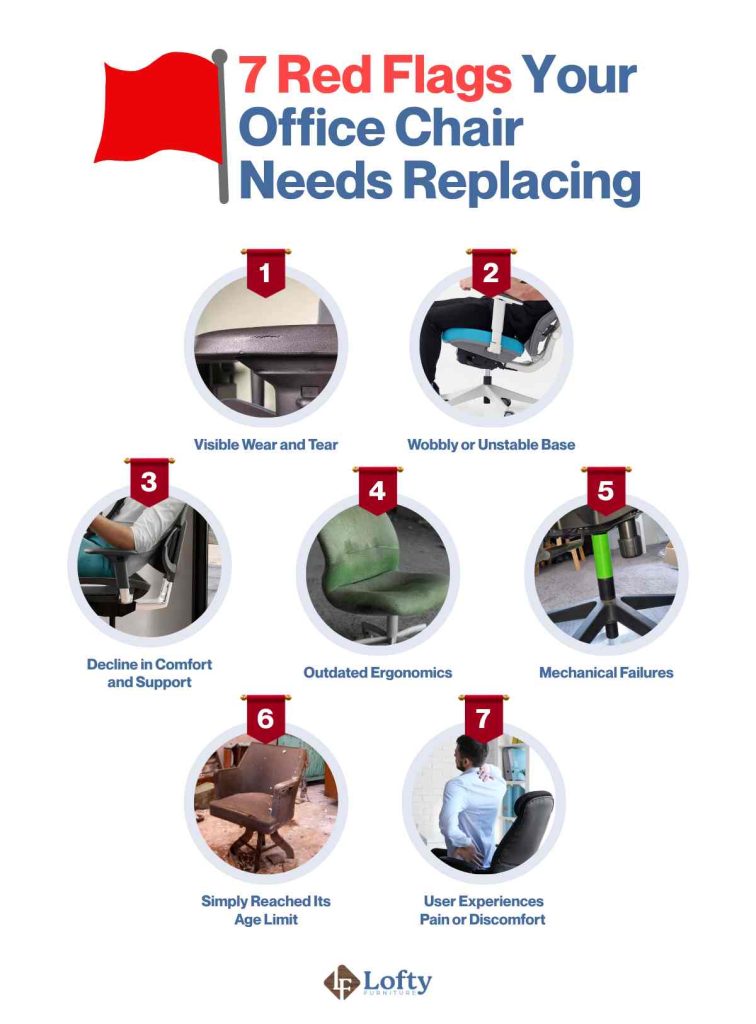
Don’t wait for total failure—these indicators mean your chair has passed its safe service life.
Flattened or Uneven Seat Cushion: When foam loses more than 25% of original height or develops permanent lumps, ergonomic support disappears. This creates hip misalignment causing fatigue within 2 hours. Test: Place a ruler vertically against your seat—any compression beyond 1 inch means replacement time.
Persistent Aches and Pains: Experiencing discomfort after 2–3 hours that persists despite micro-adjustments indicates degraded lumbar or seat-pan support. Your chair has stopped supporting your body’s natural alignment. Warning: If pain continues after standing, damage may already be done.
Visible Structural Damage: Tears longer than 2 inches, cracked armrests, split leather, or bent base components compromise both safety and aesthetics. These failures rarely occur in isolation—visible damage usually indicates broader structural compromise.
Mechanical Malfunctions: Gas lifts that sink under load, tilt locks that slip, or casters that jam create unstable seating and fall hazards. Urgent fix: If your chair sinks more than 1 inch when sitting, stop using it immediately.
Audible Warning Signs: Creaking or grinding sounds from tilt mechanisms indicate worn bushings. These noises foreshadow sudden structural failure—address within 48 hours.
Maximum Lifespan Maintenance Protocol
Extend service life by 30% with this systematic care schedule:
Daily and Weekly Care
- Vacuum fabric/mesh surfaces to remove abrasive debris
- Wipe leather/vinyl with microfiber cloths to prevent particle buildup
- Critical check: Inspect casters for hair/thread tangles (causes 35% of premature failures)
Monthly Maintenance
- Apply silicone spray to gas lift and tilt mechanisms
- Tighten visible screws to manufacturer specs (over-tightening cracks plastic)
- Pro Tip: Lubricate casters monthly—dry wheels accelerate floor damage
Quarterly Deep Care
- Fabric: Upholstery cleaner + soft brush → air dry 24 hours
- Leather: pH-balanced cleaner → conditioner (never skip this step)
- Mesh: Mild soap solution → thorough rinse → air dry away from sun
- Warning: Never use ammonia-based cleaners on mesh—they destroy elasticity
Annual Component Replacement
- Replace gas cylinders when sinking occurs (prevents base stress)
- Swap casters when tread wears below 50% (prevents floor scratches)
- Re-apply fabric guard/leather protector annually
- Cost saver: Gas lifts cost $25–$45 online—replace yourself in 10 minutes
Replace vs. Repair: The $1,200 Decision Tree
Make smart financial choices with this data-driven framework:
Budget Chair ($200 or less): When multiple failures appear after 3+ years, replacement at $150–$300 provides new warranty coverage. Repair rarely makes sense—labor often exceeds 50% of replacement cost.
Mid-Range Chair ($400): Gas lift failure justifies $30–$60 cylinder replacement plus one hour labor. This 10–15% investment extends life 3–5 years—far better than full replacement.
Premium Chair ($1,200): Re-upholstering leather costs $200–$400 but adds 5–7 years. This 17–33% investment prevents $1,200 replacement costs while maintaining proven ergonomic fit.
Mesh Panel Replacement: Stretched mesh on ergonomic models runs $80–$150 professionally—significantly cheaper than $600+ replacement while preserving ergonomic benefits.
Strategic Replacement Planning for Teams
Organizations save 22% annually with systematic approaches:
- Fleet Rotation: Replace 20% of chairs yearly to cycle inventory within 5 years
- Asset Tracking: Log purchase dates + usage hours (IoT sensors cut failure rates by 30%)
- Budget Rule: Allocate $250 per seat annually—covers depreciation + refresh cycles
Critical insight: The hidden cost of poor ergonomics ($4,800/employee annually in lost productivity) dwarfs chair replacement costs.
Final Decision Framework: When to Pull the Trigger
Your chair’s expiration date isn’t just about years—it’s about recognizing when declining support compromises health. Budget for replacement when your chair reaches 75% of its expected lifespan for your usage pattern. For a $500 chair used 8 hours daily, that’s year 5—not year 7.
Remember: The $300 replacement cost pales next to the $18,000 annual productivity loss from poor ergonomics. Invest in quality, maintain systematically, and replace strategically. Your spine—and your bottom line—will thank you.


