
Your office chair sinking mid-workday isn’t just annoying—it’s a productivity killer. That familiar slump forcing you to readjust every 30 minutes happens when your chair’s pneumatic gas cylinder fails, a near-universal issue after 3-7 years of use. The good news? You can implement emergency fixes today or permanently solve how to stop office chairs from sinking for under $50. This guide delivers field-tested solutions from immediate clamp hacks to professional-grade replacements, all verified through hands-on repair experience.
Why Your Office Chair Keeps Sinking Unexpectedly
Office chairs rely on a sealed pneumatic cylinder containing pressurized nitrogen gas and oil to maintain height. As internal rubber seals degrade from daily compression cycles, gas escapes and your body weight gradually compresses the mechanism. Heavy users (over 250 lbs) often see failure within 3 years, while standard office use typically triggers sinking after 5-7 years. Temperature fluctuations accelerate this—cold conditions thicken internal oil, causing faster leaks.
Critical Warning Signs Before Total Failure
- Hissing sounds during height adjustments signal active gas leakage
- Oil residue around the cylinder base indicates seal rupture
- Sticky lever operation reveals contaminated internal mechanisms
- Progressive sinking speed (from hours to minutes between drops) shows accelerating failure
Diagnose Your Sinking Chair in Under 5 Minutes
Pinpoint your exact failure pattern before choosing a solution. These tests reveal whether you need temporary relief or permanent replacement.
The Height Lock Assessment
Sit fully in your chair and pull the height adjustment lever while lifting your weight slightly. If the chair drops instantly to its lowest position, your cylinder has complete seal failure. Partial sinking indicates degrading seals where gas leaks slowly under pressure. For intermittent issues, repeat the test after sitting for 20 minutes—temperature changes often worsen leaks.
Weight Shift Failure Mapping
Shift your weight forward while seated normally. If sinking occurs only when leaning forward, your tilt mechanism is faulty, not the gas cylinder. Side-to-side sinking suggests loose base connections. Document which movements trigger drops—this determines if clamp fixes will work or if full disassembly is required.
Stop Office Chairs from Sinking Today: 3 Emergency Fixes

When you need immediate relief before your next meeting, these household-item solutions take 5 minutes with no tools beyond a screwdriver. All preserve your preferred ergonomic height while buying time for permanent repairs.
Hose Clamp Height Lock (Most Reliable Temporary Fix)
This creates a physical barrier preventing cylinder compression at your ideal working height.
What you need:
– 2-3 inch stainless steel hose clamp ($3 at hardware stores)
– Rubber strip (cut from old bike tube) or electrical tape
– Flathead screwdriver
Step-by-step:
1. Adjust chair to your perfect seated height
2. Slide the plastic telescoping cover upward to expose the metal shaft
3. Wrap rubber strip around the shaft where it meets the chair base
4. Position the clamp over this junction point and tighten gradually
5. Test by sitting—clamp should prevent downward movement while allowing upward adjustment
Pro tip: Tighten until resistance increases slightly, then stop. Over-tightening cracks the cylinder shaft. Expect 4-6 months of reliability before readjustment.
PVC Pipe Spacer Method (Height-Specific Solution)
Ideal for shared workspaces where multiple users need different heights.
Materials:
– 1.5-inch diameter PVC pipe (½ inch thick)
– Hacksaw or PVC cutter
– Sandpaper (120-grit)
Steps:
1. Measure exposed shaft length at your ideal height (typically 3-6 inches)
2. Cut PVC to exact measurement and sand edges smooth
3. Slide pipe over the cylinder shaft—it acts as a permanent stop
4. Paint black with spray paint to match chair aesthetics
Warning: Never force the pipe downward—this damages internal mechanisms. This method eliminates height adjustability but provides infinite stability.
C-Clamp Emergency Stop (Instant Fix)
For immediate crisis intervention when no hose clamp is available:
1. Position a large C-clamp at the cylinder’s base where it enters the chair mechanism
2. Tighten gradually while testing stability
3. Wrap clamp jaws with cloth to prevent shaft scratches
Limitation: Only lasts 1-2 weeks before slippage occurs.
Replace Your Office Chair’s Gas Cylinder Permanently
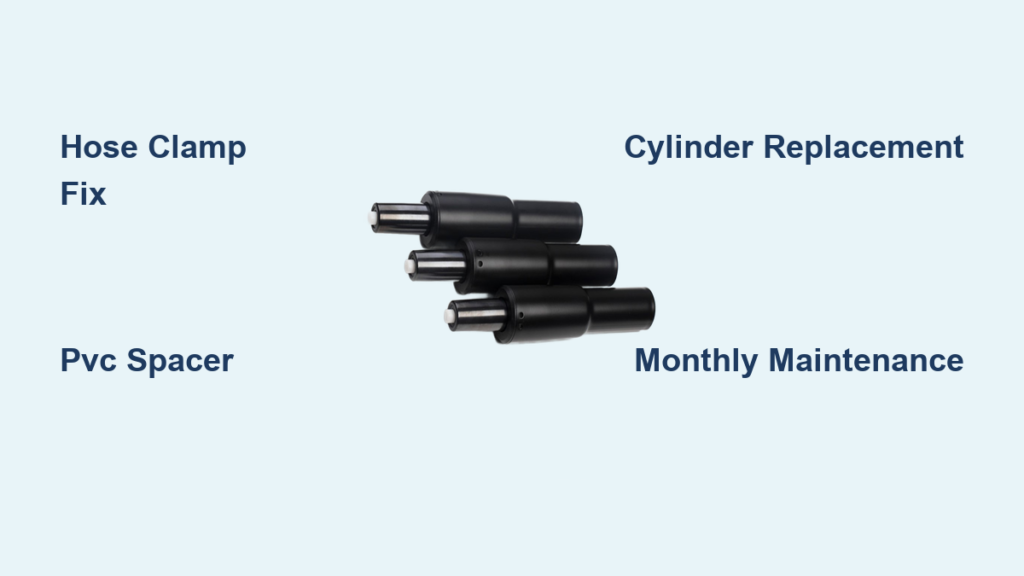
For chairs under 8 years old with intact frames, cylinder replacement restores factory performance for $20-$50. This 30-minute repair eliminates sinking permanently when done correctly.
Find Your Exact Cylinder Match

Critical measurements (remove old cylinder first):
– Diameter: 99% of chairs use 28mm standard (measure with calipers)
– Stroke length: Common sizes are 100mm, 120mm, or 160mm (measure compressed vs extended length)
– Base diameter: 50mm or 60mm (determines base compatibility)
Where to buy:
– Amazon: Search “28mm office chair gas lift” + your stroke length (e.g., “120mm”)
– Office depot: Bring old cylinder for in-store matching
– Avoid generic “universal” cylinders—they fail within months
Professional-Grade Replacement Steps
Tools needed: Rubber mallet, penetrating oil, pipe wrench, safety glasses
- Flip chair upside down on cardboard-covered surface
- Remove base: Tap base edges evenly with rubber mallet while pulling downward
- Detach seat mechanism: Unscrew 4-6 bolts connecting seat to cylinder
- Extract old cylinder: Apply penetrating oil, use pipe wrench if stuck (wrap jaws with cloth)
- Install new cylinder: Press firmly until you hear a distinct click
- Reassemble: Reverse steps and test height adjustment
Red flags during installation:
– No click sound: Cylinder isn’t fully seated—reinsert with more force
– Wobbly base: Clean cylinder base socket with alcohol before installation
– Stiff lever: Apply silicone lubricant to shaft (never oil-based products)
Prevent Office Chairs from Sinking with Monthly Maintenance
Extend cylinder life by 3+ years with these simple habits that address the root causes of seal failure.
Quarterly Deep Maintenance Protocol
- Wipe cylinder shaft with dry microfiber cloth to remove abrasive dust
- Apply silicone-based lubricant sparingly to shaft (prevents seal drying)
- Inspect plastic telescoping cover for cracks—if damaged, replace immediately
- Tighten all visible bolts on seat mechanism and base
Critical Usage Habits That Prevent Failure
- Never exceed 80% of weight limit (e.g., 240 lbs on 300-lb rated chairs)
- Avoid rapid height changes—adjust slowly to reduce seal stress
- Distribute weight evenly—sitting on chair edges accelerates wear
- Keep away from heating vents—temperature swings degrade seals 40% faster
When to Replace Your Entire Chair
Stop sinking issues permanently by upgrading when:
– Frame damage appears (cracks near cylinder socket or base welds)
– Multiple components fail (tilt mechanism + sinking = systemic wear)
– Repair costs exceed 50% of a new ergonomic chair’s price
– Chair age exceeds 8 years—even new cylinders fail prematurely in aged frames
Smart upgrade path: Choose manual height chairs (screw-type or pin-lock) that eliminate gas cylinders entirely. Drafting chairs with crank mechanisms offer infinite adjustability without failure points.
Quick Decision Guide: Fix Sinking Office Chairs in 5 Minutes
| Situation | Best Solution | Time Required | Cost | Longevity |
|---|---|---|---|---|
| Chair sinking during critical work | Hose clamp method | 5 minutes | $3 | 4-6 months |
| Chair 3-8 years old, frame intact | Cylinder replacement | 30 minutes | $25 | 5+ years |
| Chair under warranty | Manufacturer replacement | 3 days | $0 | Full warranty |
| Multiple failures + frame cracks | New manual-height chair | N/A | $120+ | Lifetime |
Your sinking chair isn’t dead—it’s a solvable mechanical issue. Start with the hose clamp emergency fix while ordering your exact cylinder replacement. For under $30 and 30 minutes of effort, you’ll restore reliable height adjustment for years. Remember: consistent monthly maintenance prevents 80% of future sinking problems. Implement the PVC spacer method for shared workspaces today, then replace the cylinder within two weeks for permanent relief. With these proven techniques, you’ll never endure that frustrating mid-workday slump again.


