
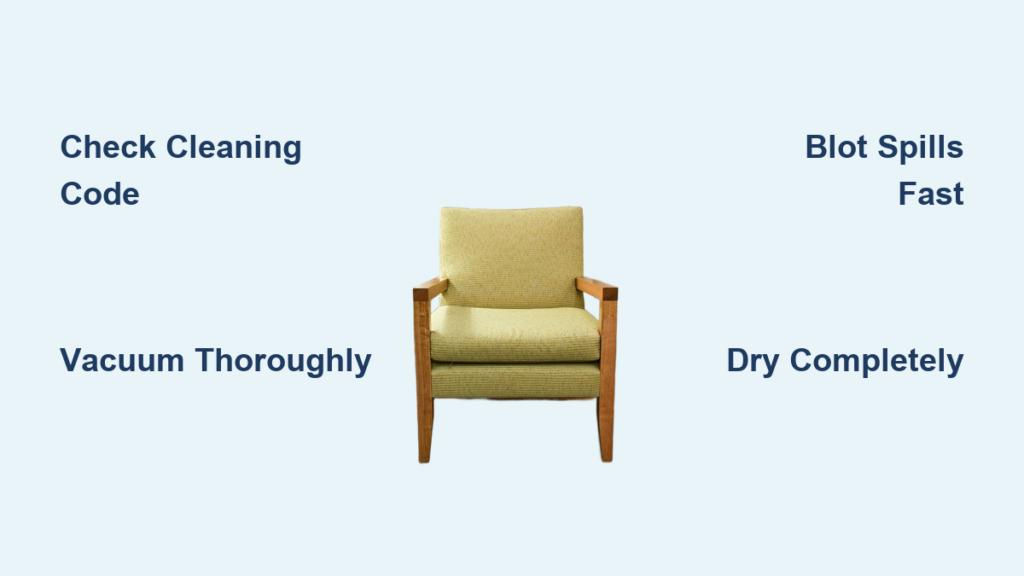
That first coffee splash on your cream sofa. The mysterious toddler handprint on the armrest. The stubborn grease mark from last week’s snack attack. Fabric chairs absorb life’s messes while silently judging your cleaning skills. But here’s the truth: how to clean upholstery fabric chairs successfully isn’t about harsh chemicals or professional equipment—it’s about matching your method to your fabric’s hidden language. Skip this step, and you’ll turn minor stains into permanent damage. Do it right, and you’ll revive even decade-old upholstery in under two hours.
Most homeowners make the fatal mistake of grabbing the nearest cleaner without checking their chair’s secret code. That tiny tag hiding under the cushion? It’s your upholstery’s DNA. Ignore it, and you’ll shrink velvet, bleach colors, or glue dirt deeper into fibers. This guide cuts through the guesswork with manufacturer-approved techniques that actually work. You’ll learn to identify your fabric’s cleaning language, tackle 95% of stains with pantry staples, and dry chairs without mold risks—all while avoiding costly replacement fees.
Decode Your Upholstery Cleaning Codes Before Touching Water

Flip cushions and peer under seat frames immediately. That 1″x2″ tag holds your chair’s cleaning passport with four critical codes: W (water-safe), S (solvent-only), WS (water or solvent), and X (vacuum only). Mistaking an S-coded chair for W? Water-based cleaners will leave permanent rings in synthetic fabrics like polyester blends. Finding no tag? Assume X code—especially on antiques or silk—and call professionals before proceeding.
Critical pre-cleaning checks:
– Test cleaners on hidden areas (back bottom corner) for 10 minutes
– Verify colorfastness by dabbing with damp white cloth
– Document existing rips or loose threads
– Remove all cushion covers per manufacturer instructions
Vacuum Every Hidden Corner Before Wet Cleaning
Skip this 5-minute step, and you’ll grind dirt into fibers during washing. Use your vacuum’s crevice tool first on:
– Button tufts where crumbs accumulate
– Armrest seams collecting skin oils
– Under cushions (the dirt graveyard)
– Back-to-seat joints trapping pet hair
Switch to the upholstery brush attachment next. Start at the top and work downward in slow, overlapping passes. For high-pile fabrics like chenille, vacuum with the nap direction only—against it pulls threads. You’ll remove 80% of surface grime before liquids touch the fabric, preventing muddy discoloration.
Remove Fresh Spills in 60 Seconds Flat
Time is your secret weapon against set-in stains. For juice, wine, or coffee spills:
1. Blot immediately with dry microfiber cloth (never rub!)
2. Sprinkle table salt or cornstarch on oily spills to absorb grease
3. Wait 3 minutes, then vacuum powder residue
4. Apply dish soap solution (¼ tsp per cup water) only to stain edges
5. Work inward with clean cloth sections to avoid spreading
Rushing this? You’ll push liquid deeper. Patience pays: 90% of fresh stains vanish with this sequence alone.
Target 4 Common Stains with Precision
:max_bytes(150000):strip_icc()/RemoveStain_OutdoorandHousehold-4c99ad272b9c4474b844278a681f61e6.jpg)
Grease Marks from Snacks or Hair
Cover the stain with baking soda paste (3 parts baking soda, 1 part water). Let sit 20 minutes—the paste pulls oil to the surface. Vacuum thoroughly. For residual shine, dab once with dry-cleaning solvent on white cloth. Never scrub; blotting lifts without spreading.
Pet Accidents That Smell Like Ammonia
Use cold water only—heat bonds proteins to fibers. Blot urine with dry towels, then apply enzyme cleaner per bottle instructions. Cover with plastic wrap for 1 hour to trap moisture against fabric. Remove, then blot with damp cloth. Repeat until odor disappears; residual smells attract repeat offenses.
Ink Stains from Pens or Markers
Dip cotton swab in rubbing alcohol. Dab only the stained area’s perimeter, working toward center. Blot with clean cloth after each dab. Stop when ink transfers—over-saturating spreads color. Test alcohol on hidden area first; some dyes bleed.
Mystery Food Stains (Unknown Origin)
Mix equal parts white vinegar and water. Spray lightly, wait 5 minutes, then blot. Vinegar neutralizes odors while loosening organic matter. Avoid on silk or acetate—vinegar can etch delicate fibers.
Deep Clean W-Coded Fabric in 7 Steps
Water-safe chairs (most cotton, linen, acrylic) need this gentle process:
1. Whip ¼ tsp dish soap with 1 cup warm water until foamy
2. Dip brush in suds only—no dripping liquid
3. Scrub in 6″x6″ sections using circular motions
4. Rinse brush every 30 seconds in clean water
5. Wipe residue with damp microfiber cloth (no soap)
6. Blot excess moisture with dry towels
7. Air-dry 6+ hours with fans circulating air
Critical mistake to avoid: Soaking fabric. Dampness trapped in cushion cores breeds mold. Press towels against seams—if they come away wet, add more drying time.
Revive S-Coded Chairs Without Water
Solvent-only fabrics (many olefin, acrylic blends) demand special handling:
– Use only dry-cleaning solvent or manufacturer-approved cleaner
– Apply to white cloth first, never directly on chair
– Blot stains gently—no circular scrubbing
– Work in ventilated areas (open windows + fans)
– Allow 24 hours for full evaporation before reuse
Never substitute rubbing alcohol for commercial solvents—it can dissolve synthetic fibers. Test solvents on hidden areas; some cause stiffening.
Steam Clean Only When These Conditions Exist
Use steam ONLY if:
✅ Fabric tag shows W code
✅ Chair shows overall dinginess (not spot stains)
✅ You own or rent a low-moisture upholstery steamer
Procedure:
1. Fill tank with distilled water only
2. Use lowest heat setting with upholstery attachment
3. Pass steamer slowly (1 inch/second) over fabric
4. Hold 2 inches from surface—closer melts fibers
5. Vacuum excess moisture immediately after
Stop if: Fabric feels warm to touch (indicates over-saturation) or shows water rings.
Dry Fabric Chairs Completely in 4 Hours
Moisture hiding inside cushions ruins chairs faster than stains. Accelerate drying with:
– Fan placement: Position oscillating fan 3 feet from chair
– Cushion rotation: Flip every 30 minutes
– Absorbent boost: Insert dry towels between cushion layers
– No sunlight: UV rays fade colors; dry in shaded room
Dryness test: Press palm firmly on fabric for 10 seconds. No coolness? Dry enough for use. Rushing causes mildew within 48 hours.
Apply Fabric Protector to Prevent Future Stains
After 24 hours of drying, spray fabric protector:
1. Shake can vigorously for 30 seconds
2. Hold 6 inches from fabric surface
3. Apply thin, even coat (no pooling)
4. Let cure 12 hours before use
Reapply every 6 months for high-traffic chairs. This invisible shield causes liquids to bead up for 15+ minutes—giving you time to blot before stains set.
Fix Lingering Odors and Water Rings Fast
Musty Smells After Drying
Sprinkle baking soda liberally over entire chair. Let sit 12+ hours (overnight ideal). Vacuum thoroughly with crevice tool in seams. Repeat if odor persists—baking soda neutralizes compounds at molecular level.
White Water Rings
Dampen entire affected area (not just ring) with distilled water. Blot evenly with microfiber cloth. Dry with fan. The ring disappears when moisture evaporates uniformly—spot-treating makes rings worse.
Know When to Call Pros for Upholstery Cleaning
Stop DIY efforts immediately if:
– Fabric shows X code (common on silk, velvet, antiques)
– Stains cover >30% of chair surface
– You see bubbling or texture changes after cleaning
– Odors return after 3 baking soda treatments
Professionals use pH-balanced solutions and moisture meters to prevent damage. For $75-$150 per chair, they’ll save heirloom pieces you might otherwise trash.
Save $200 With This Maintenance Schedule
Weekly: Vacuum high-use chairs (5 minutes)
Monthly: Spot-treat new stains within 1 hour
Every 3 months: Full deep clean using this guide
Annually: Reapply fabric protector
Skipping maintenance? Stained chairs lose 40% resale value within 2 years. A $10 bottle of dish soap protects your $500+ investment better than any warranty.
How to clean upholstery fabric chairs properly transforms panic into pride. Start with code identification, match solutions to stains, and never skip drying. Your chairs weren’t designed to stay pristine—they were built to endure life’s messes. Now you know how to honor that design without breaking the bank. Grab your vacuum and that hidden tag; your chairs will thank you for years.


